For lenders and equity investors

We build your muscle. We do not rent you ours.

Commercial diligence that doesn't stop at close. We check every number and test every claim, from the first look to the day you exit, inside the Microsoft 365 your team already uses.

The whole storySix lines
  1. WhoLenders and equity investors in the same operating companies
  2. WhyAre the numbers real, and will the story still be true next year?
  3. WhatA Diligence File before you commit, then a monthly check and a weekly watch
  4. HowCode does the math. AI reads and drafts. Your analyst signs.
  5. WhereInside your own Microsoft 365, with every deal room from day one
  6. StartA paid 30-day pilot on three companies you already hold
First lookCommitEvery monthEvery weekExit or final payment
Ten short chapters

Start anywhere. Each one takes a minute.

Pick the question you care about most. Every chapter opens on its own, shows you something you can try, and points to the next one.

Two paid pilots are under way.

Chapter 01Why it matters

Most deals get checked once. Yours keep changing.

A quality of earnings report tells you the numbers were right on one day. We keep asking the two questions that matter, every month, until you exit.

The numbers

Are they real?

Usually checked once, by a quality of earnings report, before close.

The story

Will it still be true next year?

Usually tested once, by a commercial diligence firm, and only on the biggest deals.

Today
After close: the company's own reporting, taken as reported
With CreditSwan
Both questions, on every deal, from first look to exit
First lookCommitExit or final payment
In more detail
Lenders and owners ask the same thing

A lender wants to know the covenant holds. An owner wants to know the plan holds. Both depend on whether last year’s figures are real and whether next year’s story survives contact with the market.

Once is not enough

A quality of earnings report and a commercial study are snapshots. After close, most teams read the company’s reporting as it arrives. We rebuild that reporting every month and watch the story every week until exit or final payment.

Chapter 02Who it's for

Same company. Two sides of the table. One set of facts.

Lenders want to know the covenant holds. Owners want to know the plan holds. Both answers come from the same evidence, so we check it once and serve you both.

Lenders

Direct lenders, BDCs and credit arms of asset managers

Underwriting a new credit, then holding it to the agreement for years.

“Does the covenant hold?”

The operating companyConsumer products and services · commercial services · food and beverage
One body of evidenceDeal room · monthly reporting · outside evidence · your past deals
Equity investors

Private equity sponsors, deal teams and operating partners

Testing the thesis before the LOI, then holding the company to the plan.

“Does the plan hold?”

Portfolio teamsEvery package and every covenant or plan test, checked across a growing book without growing the team.
Deal teamsCommercial diligence on every deal, not only the big ones, next to the quality of earnings work you already buy.
Sponsors and operating partnersDemand, pricing and competition tested before the LOI, then watched after close.
Chapter 03What we do

Four jobs, from the first look to the last payment.

Before you commit, every month, every week, and across the companies you already hold. Nothing new is asked of the company. Your analyst signs everything.

01
Before you commit

Diligence File

Every financial and commercial claim in the deal room, tested. It becomes the baseline.

LendersUnderwriting and the credit memoOwnersThe thesis before the LOI
02
Every month

Reporting check

Each reported figure rebuilt from the schedules underneath it.

LendersTo the credit agreementOwnersTo the plan and the board pack
03
Every week

Weekly watch

Outside signals held against the baseline. Quiet until something moves.

LendersEarly warning before a testOwnersEarly warning against the plan
04
Your book

Existing holdings

Loans and companies you already hold, added one at a time.

LendersBack-book borrowersOwnersPortfolio companies

Then ask your history. “What happened the last time a franchise system missed its plan?” Every deal room and memo you own becomes a knowledge graph in your tenant, and the answer cites your own files.

In more detail
Diligence File

Before you commit, we test the management case, the quality of earnings and every commercial claim against the deal room, outside evidence and your own past deals. Each claim gets a ruling. You get it three ways: interactive for the deal team, PDF for committee, Excel for analysts.

Reporting check

Every month, each reported figure is rebuilt from the schedules underneath. For a lender that means the credit agreement’s own definitions. For an owner it means the management accounts held to the plan and the board pack.

Weekly watch

Every week, outside signals such as foot traffic, search demand and reviews are read against the baseline set at close. Nothing is sent while they stay inside the band. When one leaves it, your analyst gets one note with the evidence.

Existing holdings

Loans and companies already on your book join one at a time, from the files you already hold. Each gets a baseline, then the same monthly check and weekly watch.

Chapter 04Commercial diligence

The spreadsheet says what happened. We find out if it lasts.

We test the business against the world outside the deal room. Forty angles. We pick the ones your deal turns on, and we keep watching after close.

Your thesissplit into claims a committee can rule on
Foot traffic
Marketing
Pricing
Customer file
Labor
Supply chain
Unit economics
Competition

Forty angles. Four possible answers. No adjectives, no “broadly in line”.

Every claim gets one ruling
Supported
Partly supported
Contradicted
Not enough evidence yet
Tested against outside evidence
Foot trafficCard spendSearch demandCustomer and employer reviewsJob postingsLocal pricesCensus trade areasPublic price and wage seriesPublic filingsRegulatory and court records

Licensed and public sources, read inside your Microsoft 365. Every figure carries its source and the date it was read.

Synthetic example

Make the call yourself.

Three claims from an invented management case. Pick your ruling on each, then see what the evidence said.

0 of 3 called

Claim 1 · Project Fern

“The decline sits in a few sites. Close them and it is cured.”

Claim 2 · Project Fern

“Comparable sales are flat.”

Claim 3 · Project Fern

“The first-year plan is achievable.”

Synthetic example

Fifteen claims from three management teams. Not one held up in full.

Projects Fern, Larch and Sorrel, all invented. This is what a committee sees before it votes.

0 supported7 partly4 contradicted4 not enough evidence
Angle explorer

All forty angles, and the kind of answer each one gives.

Every finding is invented, to show the kind of answer each angle gives.

Chapter 05How it works

Machines do the math. Your people make the call.

Code rebuilds every figure from the schedules underneath. AI reads and drafts. A named analyst on your team signs each finding before anyone else sees it.

What comes in
The deal roomEvery file, from the first day
Monthly reportingForwarded the way it arrives
Outside evidenceLicensed and public sources
Your past dealsMemos, outcomes, lessons
What happens
Code rebuilds every figureFrom the schedules, on your definitions
AI reads and draftsIt never does the math
Claims get testedAgainst evidence and your history
Who decides
Your analyst signsEvery figure, ruling and alert
Where it lands
OutlookThe reply, in the same thread
SharePointFiles and the portfolio view
ExcelThe workbook updates itself
TeamsOnly when something is wrong
Try it · the monthly check

The package says 3.75x. Let’s check it against the agreement.

Leverage
Limit 4.57x
3.75x
Headroom18%As reported
  1. 1
    Synergies from an acquisition that has not closedThe agreement allows synergies only once a deal completes.
  2. 2
    Costs for sites not yet open, added back for a third yearThe agreement caps this add-back at two years.
  3. 3
    Retention bonuses called one-offPaid in each of the last three years, so not one-off.
Synthetic Project Juniper · August packageClause 22.1 · Schedule 4
The weekly watchSynthetic · Project Juniper

Nobody has to go looking for trouble. It finds your analyst.

−8%−4%0%+4%BAND SET AT CLOSEWK 1THIS WEEK −7.8%

One note to your analystSame-site visits across 42 locations are down 7.8% year on year over the last four weeks. That is below the band set at close (−3% to +5%) for the third week running.

In more detail
Code does every calculation

Every figure is rebuilt by code from the schedules underneath, on your definitions: the credit agreement for a lender, the plan for an owner. Same input, same answer, every step traceable.

AI reads and drafts

Models read documents, find the schedules and draft the findings and the reply. They never produce a number that goes to committee.

Your analyst signs

A named analyst signs every figure, ruling and alert before anything goes out. Every verdict links to the source document, the definition used and the person who signed.

It lands where you work

The reply goes back in the same Outlook thread, files and the portfolio view live in SharePoint, the workbook in Excel updates itself, and Teams only hears about exceptions.

Chapter 06Microsoft 365

No new logins. No new home for your data.

CreditSwan is installed in your own Microsoft 365 and Azure tenant, on your Fabric and Copilot, with every deal room readable from day one. Our engineers set it up, run it with you and support it.

CreditSwan engineersConfigure, implement and support it
Your Microsoft 365 and Azure tenant
OutlookPackages in, checked replies out
SharePointEvery deal room, readable from day one
ExcelThe workbook stays current
TeamsSpeaks up only on exceptions
CopilotAnswers questions about your deals
FabricThe knowledge graph you own
AzureModels run in your subscription
Your rulesYour identity, access and retention controls
A vendor cloudNothing of yours is copied to one
No new loginsYour team keeps working in Outlook, Excel, SharePoint and Teams.
Day oneEvery deal room is readable from the start.
Your AzureModel usage runs through the agreement you already have.
Yours to keepThe graph, the files and the workbook stay with you if you leave.
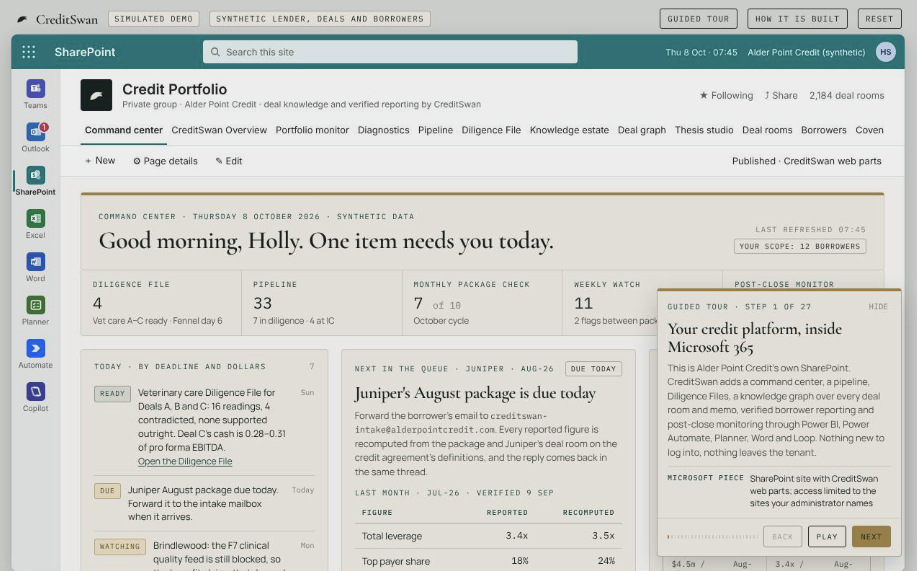
See it for yourselfWalk through a working demo inside Microsoft 365.A package lands in Outlook, the check runs in Excel, an exception reaches Teams. Built on an invented lender.Open the demo →
In more detail
Security

It runs in your tenant, so your identity, access and retention controls govern it from the first day. We answer your security questionnaire in writing.

Leaving

The graph, the files and the workbook already sit in your tenant. If you leave, we remove our engine and everything else stays.

Audit

Every verdict links to the source document, the definition used and the analyst who signed. Ready for committee and for your own investors.

Cost

It runs on what you already own: your Microsoft 365, your Fabric capacity, your Azure. Model usage runs through your own agreement, with no second AI subscription and no markup from us.

The company

The work runs on the deal rooms and reporting you already hold. Nothing new is asked of the company. Its own systems are read only in a diagnostic, and only with consent.

Copilot

Copilot helps a person work a spreadsheet. CreditSwan rebuilds each figure against your definitions, keeps the audit trail, and uses Copilot in your tenant to answer questions about your own deals.

Chapter 07Why us

Everyone reads the deal room. We check it.

You already own good tools, and each does part of the job. Here is where each one stops, and where we keep going.

Swipe the table to compare →
What the job needsQuality of earnings reportCommercial diligence firmAI document toolsPortfolio monitoring softwareCreditSwan
Rebuilds every figure on your definitions
Tests the story against outside evidence
Covers every deal, not only the biggest
Keeps going after close
Runs inside your own tenant
What it learns belongs to you
Models and compute on your own Microsoft agreement
Builds your own team’s capability
YesPartlyNoOur reading of each category's public positioning. No vendor is named.
In more detail
Your muscle, not ours

Most AI tools are rented. CreditSwan runs in your tenant on your own Microsoft agreement, so what it learns becomes your graph and your analysts’ judgment. See what you keep →

You pick the model

Job by job, inside your own Azure. Nothing about the checking depends on one model.

You keep everything

If you leave, the graph, the files and the workbook are already in your tenant.

Engineers, not a login

Our engineers set it up next to your team, then hand it over at your pace.

Chapter 08Rent or own

Most AI is rented. The edge should be yours to keep.

Most AI tools sold to investors are subscriptions: their platform, their models, their price list. What your team teaches them stays with them. CreditSwan is built the other way round, inside what you already own.

A typical AI subscriptionCreditSwan
Your files

Read into the vendor’s platformYou ask for them back

Stay in your Microsoft 365. Nothing of yours is copied to a vendor cloud.They never left

The models

Picked by the vendor, run on the vendor’s accountSwitched off with the account

Picked by you, job by job, running in your own AzureStill in your Azure

The bill

A seat, document or platform fee, with model usage priced inside itEnds, and the capability with it

Models and compute on your own Microsoft agreement, at your rates, with no markup from usYour agreement carries on

What it learns

Makes the vendor’s product betterStays with the vendor

Builds your knowledge graph in your own FabricStill in your graph

The know-how

Stays with the vendor’s teamWalks out with the vendor

Handed to your analysts by our engineersStill in your team

Your history

Kept in the vendor’s systemGoes with the account

Kept in your tenant, every verdict with its sourceStill yours, audit trail and all

See what each one leaves you with.

Our reading of how the category sells itself. No vendor is named.

The bill

Your AI bill belongs on your contract, not inside ours.

As AI becomes part of every deal, usage grows with it. That spend should sit where you can see it, steer it and negotiate it.

Rented
One fee. Platform, models and compute bundled, usage priced by the vendor.
Owned
CreditSwan: the engineers and the methodMicrosoft: your models and compute, on your agreement
One bill, not twoModels and compute run on the Microsoft agreement you already have. No second AI subscription.
No markupWe don’t resell model usage. You pay the rates you negotiated.
Every call visibleUsage shows up in your own Azure cost reports, by job and by model.
Your hand on the dialYou choose which model handles which job, and you set the budgets.

Every deal you check should make your firm harder to compete with. Not your vendor.

Each definition, red flag and sector pattern the system learns lands in your graph, in your Fabric. It compounds for your firm, and it never leaves with anyone else.
In more detail
No lock-in on models

When a better model reaches your Azure, you move the job to it. Nothing about the checking depends on one model.

Security you already run

Your identity, access and retention controls apply from the first day, because it runs where your data already lives.

Engineers who hand over

They set it up next to your team, run it with you, and hand each job over at your pace, so the skill stays in your building.

Leaving

If you leave, we remove our engine. Everything it built is already yours, in your tenant.

Chapter 09Ways to work

Start with three companies you already know.

A paid 30-day pilot on borrowers or portfolio companies already on your book, so you judge us where you already know the answers.

Self-service

Your team drives.

Our engineers install it and hand it over. Add a named engineer if you want one on call.

Concierge

We drive. You sign.

We prepare every file and check. Your analyst reads and signs. Each job hands back to your team when it is ready.

How to start

A paid 30-day pilot on three companies you already hold

Borrowers or portfolio companies, from the files you already have. The same system and the same standard at either level. Then you decide, with the results in hand.

01ScopePick three companies, the reporting to check and the level of service.
02InstallYour IT approves the install. We answer the security questionnaire in writing.
03BaselineEach deal room and agreement or plan goes in. Your analyst confirms the baseline.
04CheckReporting is checked as it lands. The weekly watch runs in between.
05DecideWe walk through the verdicts with you, and you decide about the rest of the book.

Two paid pilots are under way.

Chapter 10Samples

Don't take our word for it. Open the file.

A complete Diligence File and a working Microsoft 365 demo, built on invented companies so we can show you every page. Both open with a work email, straight away.

Sample · veterinary care · three deals

The Diligence File

What a deal team gets before committee: the sector, the multiples, a benchmark of comparable operators, a ruling on every part of the thesis and a read on each financing. Pick a part to jump straight to it.

Start a pilot

Pick three companies. We will show you what we find.

Tell us which companies you would start with and what you would check first. The pilot is paid and runs 30 days. A person answers, not a sequence. Or write to sales@creditswan.com.

Two paid pilots are under way.